
Most people assume a vacuum is created by simply pulling the air out. That is partly correct – but the engineering behind it is more interesting than it sounds, and the method you use depends entirely on how deep a vacuum you need.
Creating a rough vacuum is straightforward. A basic mechanical pump can take a chamber from atmospheric pressure down to the low millitorr range without much difficulty (Torr is a unit of pressure. For reference, atmospheric pressure at sea level is about 760 Torr. Millitorr is x/1000 Torr.)
Reaching ultra-high vacuum (UHV) – the pressure regime used in fusion research, particle accelerators, and advanced semiconductor fabrication – requires a fundamentally different approach. No single pump can take a system from atmospheric pressure to UHV. It always requires multiple technologies working in sequence, each covering a different portion of the pressure range.
Two technologies do most of the heavy lifting in UHV systems. Understanding how each one works, and why, makes the engineering logic of the whole system much clearer.
The Turbomolecular Pump: High Speed, High Volume
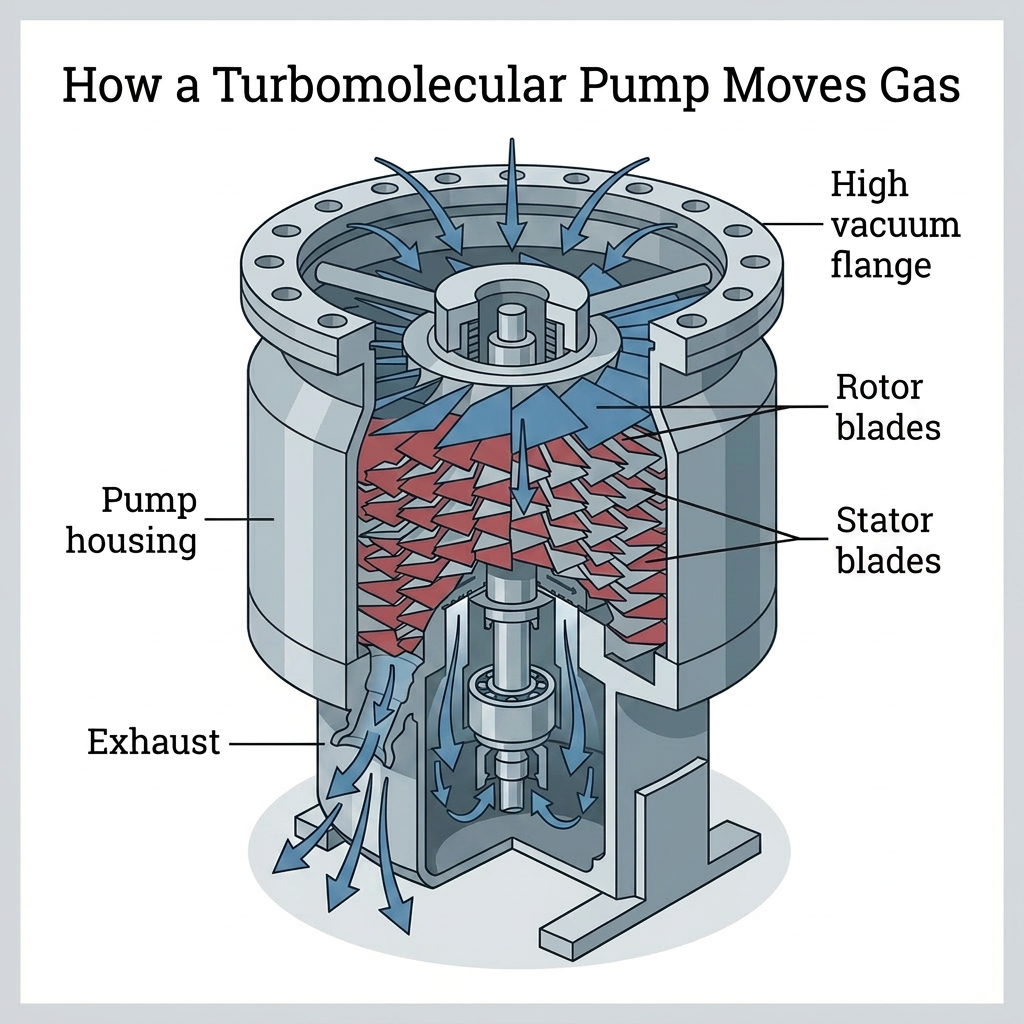
The turbomolecular pump is the workhorse of high vacuum systems. It is, in essence, a very sophisticated fan – one that spins at extraordinary speeds and is designed to work at the scale of individual gas molecules rather than bulk airflow.
Inside a turbomolecular pump, a stack of angled rotor blades spins at 24,000 to 90,000 revolutions per minute. The blade tips move fast enough to approach the average thermal velocity of gas molecules – the speed at which molecules naturally careen around at room temperature.
When a gas molecule enters the pump and collides with a moving rotor blade, it receives a momentum kick that sends it toward the pump outlet. Stationary stator blades between each rotor stage redirect molecules to set up the next collision. Stage after stage, molecules work their way from the inlet toward the outlet until they exit the pump entirely.
The result is a pump that can move large volumes of gas efficiently and reach deep into the high vacuum range – typically down to 10⁻¹⁰ torr or lower in well-designed systems. Turbomolecular pumps are fast, versatile, and can handle the large gas loads encountered when a system is first brought down from atmospheric pressure.
However, there is a tradeoff. Turbomolecular pumps have moving parts – specifically, that high-speed rotor running on precision bearings. Moving parts mean vibration, and vibration is a problem in experiments or processes that require extreme mechanical stability. They also mean wear, periodic maintenance, and eventual replacement of bearings. And because the pump cannot exhaust directly to atmosphere, it requires a backing pump – typically a mechanical roughing pump – to handle the gas it expels on the outlet side.
For many applications, these are acceptable tradeoffs. For the most demanding UHV applications, a different technology is needed for the final stage.
The Ion Pump: No Moving Parts, Indefinite Endurance
The ion pump is a fundamentally different kind of device. It does not move gas from one place to another. It eliminates gas molecules entirely by converting them into solid material that stays permanently inside the pump.
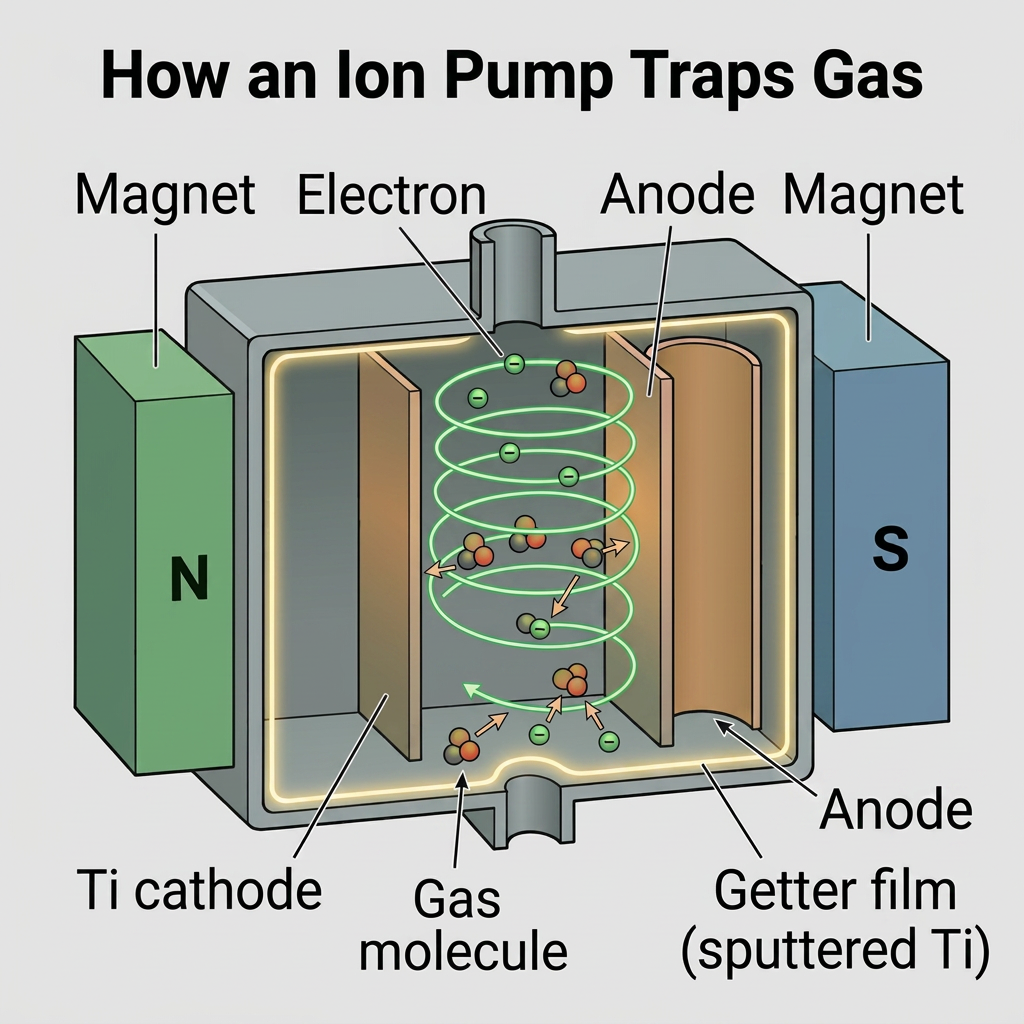
The process begins with ionization. Inside the pump, a strong magnetic field and a high electrical voltage – typically between 3 and 7 kilovolts – work together to trap electrons and force them into long, spiraling paths. These spiraling electrons dramatically increase the probability of colliding with a residual gas molecule and knocking an electron loose from it, leaving the molecule with a positive electrical charge. The molecule is now an ion.
Those positive ions are then accelerated by the electric field and slammed into titanium cathode plates at high velocity. Two things happen at the point of impact.
First, some ions simply embed themselves into the titanium lattice and stay there. This is called ion burial, and for reactive gases it is essentially permanent under normal operating conditions.
Second, the impact knocks titanium atoms loose from the cathode surface – a process called sputtering. Those displaced titanium atoms travel through the pump and deposit as a fresh, thin film on surrounding surfaces.
Freshly deposited titanium is highly chemically reactive, and it readily bonds with reactive gas molecules like nitrogen, oxygen, water vapor, and carbon monoxide – chemically locking them in place. This chemical trapping process is called gettering, and the titanium acting as the trapping material is called a getter.
Hydrogen, which does not form chemical bonds with titanium in the same way, simply diffuses into the bulk of the titanium metal and stays there.
The net result: gas molecules enter the pump and do not come back out. They are chemically bound or physically embedded in solid titanium, effectively removed from the vacuum environment permanently.
The Noble Gas Problem
The ion pump’s trapping mechanism works extremely well for reactive gases – which make up the majority of what is in air. But it runs into a fundamental limitation with noble gases: argon, helium, neon, and others.
Noble gases are chemically inert. They cannot form chemical bonds with titanium or anything else, so the getter mechanism does not work on them. The only way an ion pump can remove a noble gas is through physical burial – getting the ion embedded deeply enough in the titanium that it stays put. But noble gas ions, particularly argon, tend to be buried only shallowly. Subsequent ion bombardment of the same area can dig them back out and release them into the system again, causing periodic pressure spikes. This phenomenon is known as argon instability, and it is one of the more studied problems in UHV pump engineering.
The ion pump industry has developed several design variations to address it. Triode pumps and noble diode pumps use different cathode geometries and materials to improve noble gas pumping stability – though each comes with its own tradeoffs in cost, pumping speed for reactive gases, or operating complexity. Argon makes up about one percent of air, so any system exposed to atmosphere – even briefly – has to contend with it.
How the Two Technologies Work Together
Ion pumps cannot start from atmospheric pressure. They require the system to already be well into the vacuum range – typically below about 10⁻⁵ torr – before they can begin operating effectively. They also cannot handle large bursts of gas, which is why they are never used alone to bring a system down from atmosphere.
In practice, the two technologies are almost always paired. A roughing pump handles the initial evacuation from atmosphere down to the millitorr range. A turbomolecular pump then takes over, driving the system through the high vacuum range. Once the system reaches the point where the ion pump can engage, it takes over for the final descent into ultra-high vacuum – and then stays on to maintain it indefinitely.
That indefinite maintenance is one of the ion pump’s most important practical advantages. Because it has no moving parts, no oil, and no mechanical wear, an ion pump can run continuously for years – sometimes decades – with essentially no maintenance. It also produces no vibration, which makes it the preferred choice for sensitive instruments where any mechanical disturbance would interfere with measurements.
Choosing the Right Pump
Pump selection in a UHV system is not simply about finding the most powerful option. It is about matching the technology to the specific requirements of the system: the target pressure, the expected gas load and composition, the sensitivity of the process or experiment to vibration, the maintenance constraints of the facility, and the operating cycle of the system.
A system that is vented to atmosphere frequently has different pumping requirements than one that stays sealed for months at a time. A fusion device exposed to hydrogen plasma has different gas load characteristics than a surface science instrument working in clean UHV. A semiconductor tool where vibration could affect lithography precision has stricter mechanical stability requirements than a materials deposition chamber.
Every combination of these factors points toward a different pumping strategy. Getting it right is one of the first and most consequential design decisions in any UHV system – because everything built on top of that system depends on the vacuum being stable, clean, and reliably maintained.