
How Vacuum Engineering Powers the Technologies That Shape Our World
There is a category of engineering that makes nearly everything we consider technologically advanced possible – and receives almost none of the credit for it.
It does not have a flashy name. It does not generate breathless headlines. When a fusion experiment breaks an energy record, or a space telescope captures light from a galaxy 13 billion light-years away, nobody in the press release mentions it. And yet, without it, none of those things happen.
We are talking about vacuum engineering – the science and practice of creating, maintaining, and working within environments from which air and other gases have been removed to an extraordinary degree.
It is a discipline that encompasses entire complex systems: the chambers where experiments and manufacturing processes occur, the pumps that remove gas from those chambers, the gauges that measure pressure down to almost nothing, the seals and valves that hold everything together, and the specialized components that allow power, signals, fluids, and light to pass in and out of these environments without compromising them. Vacuum engineering is the foundation on which a surprising number of the world’s most advanced technologies are built.
What Is Ultra-High Vacuum – and Why Does It Matter?
Pressure is measured in a variety of units depending on the field, but vacuum scientists and engineers most commonly work in torr – a unit named after the 17th-century Italian physicist Evangelista Torricelli, who invented the barometer.
At sea level, Earth’s atmosphere exerts a pressure of about 760 torr. A decent vacuum pump can bring a chamber down to around 10⁻³ torr without much difficulty. But the applications that drive modern science and technology often demand far more than that.
The regime known as ultra-high vacuum, or UHV, begins at pressures below 10⁻⁹ torr – roughly one ten-billionth of atmospheric pressure. To put that in perspective, the surface of the Moon sits at around 10⁻¹² torr during the lunar night, making it one of the most extreme natural vacuums in the accessible universe.
The vacuum systems used in semiconductor fabrication, particle physics, fusion energy research, and a range of other advanced fields operate in this same general neighborhood. At these pressures, the space inside a chamber contains so few gas molecules that a particle can travel significant distances (think kilometers) without running into another one.
That freedom from interference is precisely the point. In many of the most demanding scientific and industrial processes, even a trace amount of gas is enough to ruin everything.
The Technologies That Run on Vacuum
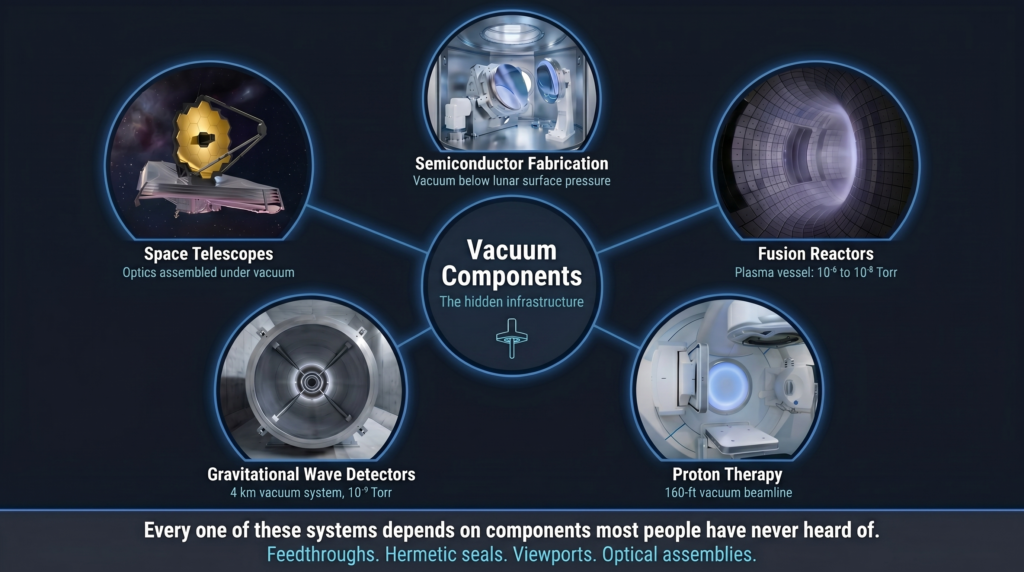
Consider the semiconductor chip. The processors and memory chips that power modern electronics are fabricated through a series of extraordinarily precise deposition and etching steps, many of which must take place inside vacuum chambers.
Ion implantation – a process in which ions of specific elements are fired into a silicon wafer to alter its electrical properties – requires vacuum conditions to ensure that the ions travel in controlled, predictable paths. A stray gas molecule in the wrong place can scatter the beam and corrupt the geometry of features measured in nanometers. The chip in a current-generation smartphone contains transistors smaller than a virus. That level of precision is only achievable in a vacuum environment.
The same logic applies, in a very different context, to proton therapy – a form of cancer treatment that delivers a focused beam of protons to a tumor with millimeter-level accuracy while minimizing damage to surrounding healthy tissue.
A proton therapy system is essentially a specialized particle accelerator, often stretching 50 to 100 meters in length. The entire beamline must be maintained under vacuum so that protons are not scattered by collisions with gas molecules before they reach their target. Pressures on the order of 10⁻⁷ torr are required throughout the system. The integrity of that vacuum – sustained across an enormous and mechanically complex system, day after day – is what makes the precision of the treatment possible.
Then there is LIGO – the Laser Interferometer Gravitational-Wave Observatory – which in 2015 became the first instrument to directly detect gravitational waves (the ripples in spacetime predicted by Einstein a century earlier).
LIGO works by splitting a laser beam and sending each half down one of two 4-kilometer arms, then measuring any difference in the time the beams take to travel their respective paths. The signal it is looking for is almost incomprehensibly small: a change in the length of those arms on the order of one ten-thousandth the diameter of a proton. Any gas molecule in the beam path introduces noise that would overwhelm that signal entirely. LIGO’s vacuum system spans 10,000 cubic meters and is maintained at 10⁻⁹ torr – one trillionth of atmospheric pressure. It is among the largest and most demanding vacuum systems ever built. LIGO changed our understanding of the universe. And, of course, it runs on vacuum.
Fusion energy research, quantum computing, thin-film solar cell manufacturing, space instrumentation – the pattern repeats across the frontier of advanced technology. Each of these fields depends on the ability to create and sustain environments that simply do not occur naturally on Earth. Vacuum engineering is what makes those environments possible.
A System Is Only as Good as What Holds It Together
Creating a vacuum is one challenge. Maintaining it – across a complex system, over years of continuous operation, while passing electricity, data signals, laser beams, and cooling fluids through the walls of a sealed chamber – is another challenge entirely.
Every vacuum system, regardless of its application, depends on an array of components whose sole purpose is to maintain the integrity of the vacuum boundary. Feedthroughs carry electrical signals and power through chamber walls without ruining the vacuum seal. Viewports provide optical access to the interior of a chamber without breaching its seal. Flanges and sealing hardware join system sections together with tolerances tight enough to hold pressure differentials that span many orders of magnitude. Pumps – ranging from mechanical roughing pumps to ion pumps and cryopumps – work in staged combinations to achieve and sustain the target pressure. Gauges monitor conditions inside the system continuously, because any degradation in vacuum integrity can compromise the process or the experiment entirely.
None of these components make headlines. When a fusion reactor achieves a record plasma temperature, or a particle accelerator produces a discovery that rewrites physics, the press coverage focuses on the science. The vacuum systems that made the experiment possible – and the components holding those systems together – are simply assumed to have worked. That assumption is only valid because a great deal of precision engineering went into making it so.
The Work Is Quiet. The Applications Are Not.
At MPF Products, we think about this a lot. Every component that leaves our facility is headed somewhere – into a research instrument, a medical system, an industrial process, or a piece of infrastructure that future generations may depend on, even if they never know our name was part of it.
That is not a complaint. It is the nature of foundational engineering: the best work disappears into the system, holds its position, and lets everything built on top of it do what it was designed to do.
This content series exists because we believe vacuum engineering deserves more attention than it gets. The science is fascinating, the engineering challenges are real and hard-won, and the applications – as we hope this post makes clear – are about as consequential as any technology being developed today. We will be exploring all of it: the history, the science, the systems, and the components. We are proud to play a role in building what comes next – one carefully engineered piece at a time.
If you’re interested in learning more about the specifics of what we engineer and build at MPF Products, more information is available at: mpfpi.com.